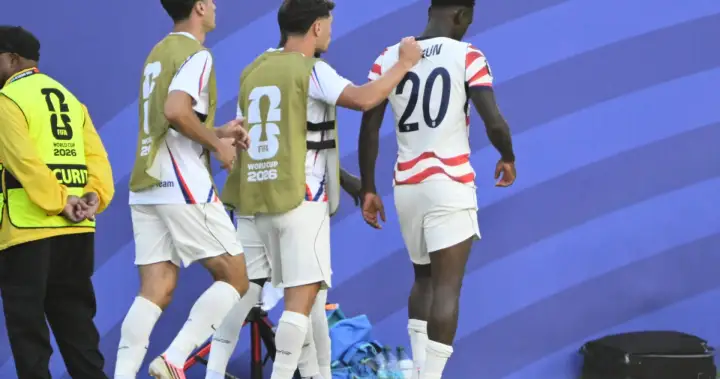
European soccer body UEFA criticized FIFA for an “incomprehensible and unjustifiable decision” to let United States forward Folarin Balogun play at the World Cup against Belgium on Monday despite a red card in his previous game.

UEFA said in a statement FIFA “crossed a red line” with its decision not to enforce Balogun’s mandatory one-game ban, after the world soccer body came under pressure from U.S. President Donald Trump.
FIFA’s ruling Sunday — to defer Balogun’s ban for one year of probation — shockingly deviated from soccer’s traditional rule of law and drew stinging criticism globally including from former World Cup stars and coaches at this tournament.
“It’s a bad, bad, bad, bad, bad decision that will hurt the World Cup,” Norway coach Ståle Solbakken said Sunday after his team beat Brazil to reach the quarterfinals.
UEFA, whose member federations include Belgium, insisted: “Sometimes rules are open to interpretation. In this case not.”
“When the certainty of rules is no longer guaranteed by its guardians, the integrity of the game is at stake and the credibility of a competition is undermined,” said the European soccer body, which has often clashed with FIFA President Gianni Infantino during his decade in power.
“We express our disbelief at such an unprecedented, incomprehensible and unjustifiable decision,” said UEFA, where Infantino was its CEO-like general secretary from 2009 until being elected to lead FIFA in February 2016.
The Belgian soccer federation was preparing an appeal in Seattle in the early hours of Monday to challenge the Balogun ruling before a FIFA-appointed appeals judge. The round of 16 game against the U.S. is due to kick off at 5 p.m. local time.
Balogun was sent off directly for planting his cleated foot on the ankle of Bosnia-Herzegovina defender Tarik Muharemovic during a 2-0 win for the U.S. in the round of 32 last Wednesday.
That kind of challenge has been a routine red card all season in competitions worldwide, and Balogun could have expected a two-game ban for serious foul play.

Get daily National news
Get daily Canada news delivered to your inbox so you’ll never miss the day’s top stories.
Still, similar challenges by star players have gone unpunished at this World Cup — by Lionel Messi for Argentina against Algeria and Morocco’s Achraf Hakimi vs. Brazil. Bernardo Silva of Portugal got just a yellow card against Congo.
“I think a yellow card would have been fair,” Balogun later suggested.
This World Cup has been remarkable for FIFA seeming to rewrite the norms of disciplinary action even before the tournament began.
A pattern of pardons opened FIFA to suggestions of executive intervention in the statutory independence of its judicial bodies.
Cristiano Ronaldo was cleared to play in Portugal’s opening World Cup game despite getting a red card for serious foul play in a qualifying game against Ireland last November. He struck an opponent with an elbow.
Ronaldo served his mandatory ban in Portugal’s final qualifying game but he was reprieved from an expected two-game ban because FIFA introduced the idea of probation. An imposed three-game ban was less meaningful as two games were deferred during a one-year probationary period.
At the opening game on June 11, South Africa’s Themba Zwane got a red card against Mexico for a similar offense to Ronaldo’s and FIFA imposed a three-game ban with no probation. Zwane did not play again at the World Cup.
Three players sent off in their teams’ qualifying games last year were surprisingly told by FIFA in May they could serve their bans in a future competition instead of at the World Cup, which was the long-standing norm.
Ecuador midfielder Moisés Caicedo, Argentina defender Nicolás Otamendi and Qatar defender Tarek Salman all had their bans waived for the World Cup.
This, FIFA said in May, was to ensure teams “can compete with their strongest possible squads on the biggest stage of men’s international football.”
The Balogun decision simply took this policy further, though not for other players shown a red card so far who were mandated to miss at least one game.
“It is a principle embedded in regulations, which cannot be made subject to exceptions,” UEFA said, “let alone in the middle of a tournament where several other players have been in the same situation and regularly served their suspension.”
© 2026 The Canadian Press