Investigation and Findings
Identification of the First Rabies Cases
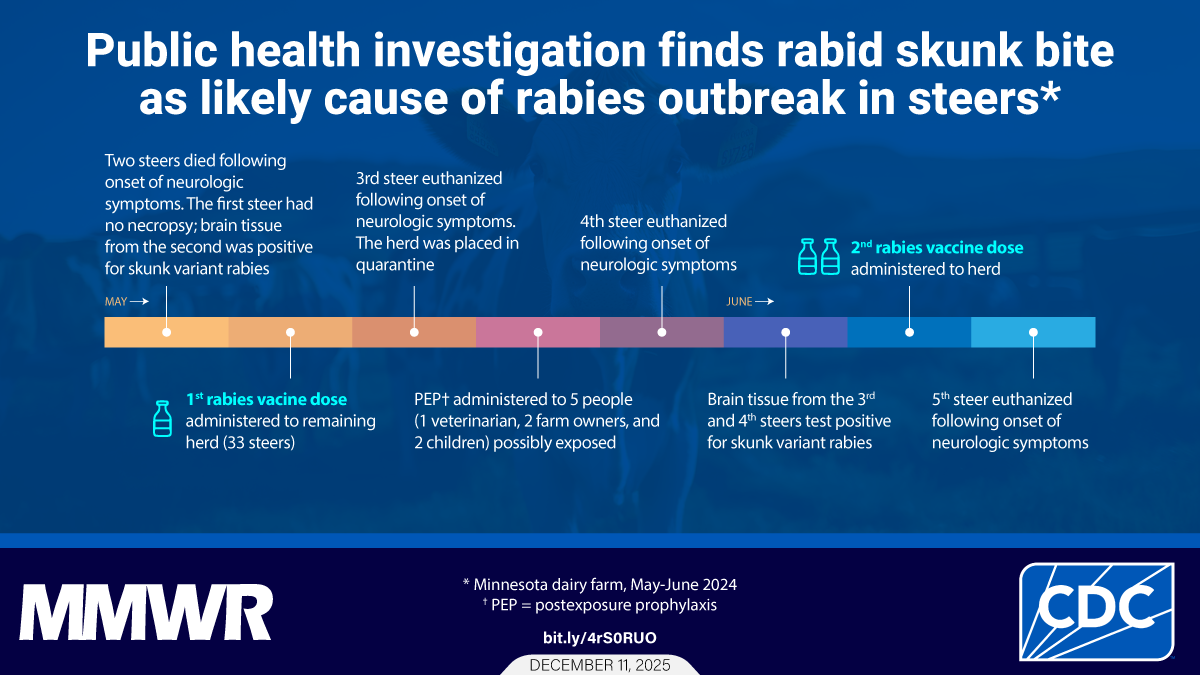
On May 11, 2024, a steer on a Minnesota dairy farm died a few days after the onset of neurologic signs including drooling, poor coordination, bellowing, and head thrashing; no necropsy was performed. On May 13, the farm owners sought veterinary care for a second steer exhibiting similar neurologic signs. The second steer was euthanized, and a sample of brain tissue was prepared at the University of Minnesota Veterinary Diagnostic Laboratory. Direct fluorescent antibody (DFA) testing of the brain tissue was performed at the Minnesota Department of Health (MDH) Public Health Laboratory and was positive for rabies on May 16. Whole genome sequencing (WGS) of the rabies virus was performed, which identified the North Central Skunk rabies virus variant. MDH and Minnesota Board of Animal Health (BAH) investigated to determine human and animal exposures. These activities were reviewed by CDC, deemed not research, and were conducted consistent with applicable federal law and CDC policy.*
Investigation and Management of Animals on the Farm
A BAH district veterinarian visited the farm premises to conduct an investigation, which included interviewing the farm owners, verifying animal vaccination histories, assessing potential rabies exposures among the animals, and establishing any necessary animal quarantines. During this investigation, the farm owners reported smelling a skunk several weeks before the onset of the first steer’s illness, although no bite to the steer was identified. None of the animals in the herd had received rabies vaccination. To decrease the risk for rabies in additional steers in the herd and human exposure to rabid animals, the herd veterinarian initiated a 2-dose regimen of postexposure rabies vaccination for the remaining 33 steers, with the first dose administered on May 18 (Figure). Because two steers from the same pen had been infected, on May 24, BAH placed the 33 steers in a pen under a 45-day quarantine for rabies observation.
One dog, that was up-to-date on its rabies vaccine, lived on the farm and had access to the steer’s carcass before burial. The dog received a rabies vaccine booster dose on May 17, and BAH placed the dog on a 45-day observation period, which consisted of the owners watching the dog closely for signs of illness, limiting contact to those inside the household, and contacting BAH if clinical signs developed. The dog remained healthy. Per National Association of State Public Health Veterinarians guidance (4), 12 unvaccinated farm cats that did not have clinical signs of rabies but might have been exposed to the rabid steers were euthanized.
On May 24 and 27, two additional steers displayed neurologic signs similar to those observed in the first two steers and were euthanized; DFA testing of brain specimens was positive for rabies virus for both animals. Because additional cases were identified after the index case, BAH extended the quarantine of the herd to 120 days to ensure that any possible steer-to-steer transmission was detected.
On June 1, the 31 remaining steers received the scheduled second rabies vaccine dose. On June 9, a fifth steer developed signs similar to those observed among the previous four steers and died; no tissue from this animal was submitted for rabies testing. WGS of rabies virus isolated from the three tested animals (steers 2, 3, and 4) (Figure) indicated that the detected North Central Skunk rabies virus variant differed by at least single nucleotide polymorphisms. No additional steers died.
Identification of Potentially Exposed Persons
MDH epidemiologists conducted interviews with six potentially exposed persons to determine whether rabies PEP was indicated. These included persons who might have had contact with saliva from or might have been bitten by a rabid steer and were not wearing appropriate personal protective equipment (i.e., gloves, eye protection, and face protection).
Five persons (one veterinarian, two farm owners, and two children) were determined to have had possible exposure to rabid steers. The veterinarian’s glove and skin were punctured during removal of an infected steer’s brain. The farm owners had extensive contact with all of the infected steers, including possible saliva contact. The children, aged <10 years, had unsupervised contact with the area where the steers were housed, and thus exposure could not be ruled out. All five persons received rabies PEP.† The four family members received the full PEP series, and the veterinarian, who had received rabies vaccine before the exposure, received 2 booster doses.