Investigation and Results
Identification of Paraburkholderia spp. in Blood Cultures
In August 2024, the Minnesota Department of Health Public Health Laboratory (MDH-PHL) noted an increase in blood culture isolates referred from clinical laboratories in Minnesota that were identified as Paraburkholderia fungorum or Paraburkholderia spp. by 16S rRNA sequencing.† Seven isolates from patients hospitalized from January to August were submitted to MDH-PHL from three laboratories to rule out Burkholderia mallei and Burkholderia pseudomallei, Tier 1 select agents with bioterrorism potential.§ P. fungorum is not an established human pathogen and has rarely been reported in clinical specimens (1–3), and MDH-PHL had not identified P. fungorum in any clinical specimens during the preceding decade. Whole genome sequencing (WGS) of the initial seven isolates found that they were closely genetically related. One laboratory reviewed previous test results, and P. fungorum was isolated from the blood cultures of eight additional patients who were identified dating back to September 2023. Because of the retrospective nature of the review and the length of time that had passed, isolates from these patients were not available for WGS. Medical record reviews of all 15 patients revealed that in several cases, the treating providers felt the likelihood of clinical infection was low and the positive blood culture represented a culture contaminant. In addition, for each patient, only a single culture bottle tested positive out of one or multiple sets of blood cultures, suggesting possible culture contamination rather than a true infection. This project was reviewed by the Minnesota Department of Health, classified as nonresearch public health surveillance, and was conducted consistent with applicable federal laws.
Identification of Additional Positive Cultures Through Statewide Review of Laboratory Records
On October 1, 2024, MDH-PHL notified clinical laboratories statewide, calling for a review of laboratory records of any clinical specimens collected after September 2023 with a positive Paraburkholderia spp. culture result. An additional 30 positive blood culture results were identified from 30 patients (one isolate per patient), including four from Minnesota, one from North Dakota, and 25 sent to a national clinical reference laboratory for further identification from clinical laboratories in 11 other states. Only the isolate from North Dakota was available for analysis.
Initially, intrinsic contamination of blood culture bottles during manufacture was suspected, because all positive cultures identified until that time involved the same blood culture system manufacturer. Among the 30 positive cultures identified during the statewide review, MDH-PHL was initially able to obtain the isolate from North Dakota for WGS. As the investigation continued into December 2024, MDH-PHL obtained five additional isolates from Minnesota laboratories from patients hospitalized from August to December 2024 that were added to the WGS analysis, for a total of 12 isolates from Minnesota (including the original seven). The additional five isolates exhibited the same genetic relatedness to one another and to the seven original isolates. MDH notified CDC, the Food and Drug Administration (FDA), and the blood culture system manufacturer of these findings.
Identification of Positive Cultures from North Carolina, Canada, and Israel
Concurrent with this investigation, Paraburkholderia spp. were identified in clinical cultures processed by laboratories in North Carolina (21 cultures), Canada (four), and Israel (10); these three jurisdictions joined the investigation in late 2024 and early 2025. Microbiologists in Canada and Israel reached out to MDH-PHL after noticing the October 1 publicly posted online laboratory alert when searching for information on P. fungorum. North Carolina joined the investigation following personal communication between MDH-PHL and laboratory staff members from two clinical laboratories in North Carolina. North Carolina joined the investigation following personal communication between MDH-PHL and laboratory staff members from two clinical laboratories in North Carolina. Among the 21 positive cultures identified in North Carolina, 19 isolates were sent to MDH-PHL (Supplementary Table). These included nine that were identified on the initial list of 25 positive cultures from 11 other states (whose original isolates remained available from the originating laboratory) and sent to the reference laboratory in Minnesota. Among the 19 isolates, 16 were successfully sequenced and added to the WGS analysis, including two isolates from cultures obtained on two different dates from the same patient. Israel and Canada performed WGS on isolates from their jurisdictions and shared results with MDH-PHL. Thus, a total of 43 isolates from 42 patients were included in the WGS analysis (12 from Minnesota, 15 from North Carolina [including one patient with two isolates], one from North Dakota, four from Canada, and 10 from Israel) (Figure 1). All isolates were recovered from blood with the exception of three from Israel, which were recovered from ascitic fluid cultured in blood culture bottles.¶
Identification of Nonsterile Ultrasound Gel as a Potential Contamination Source
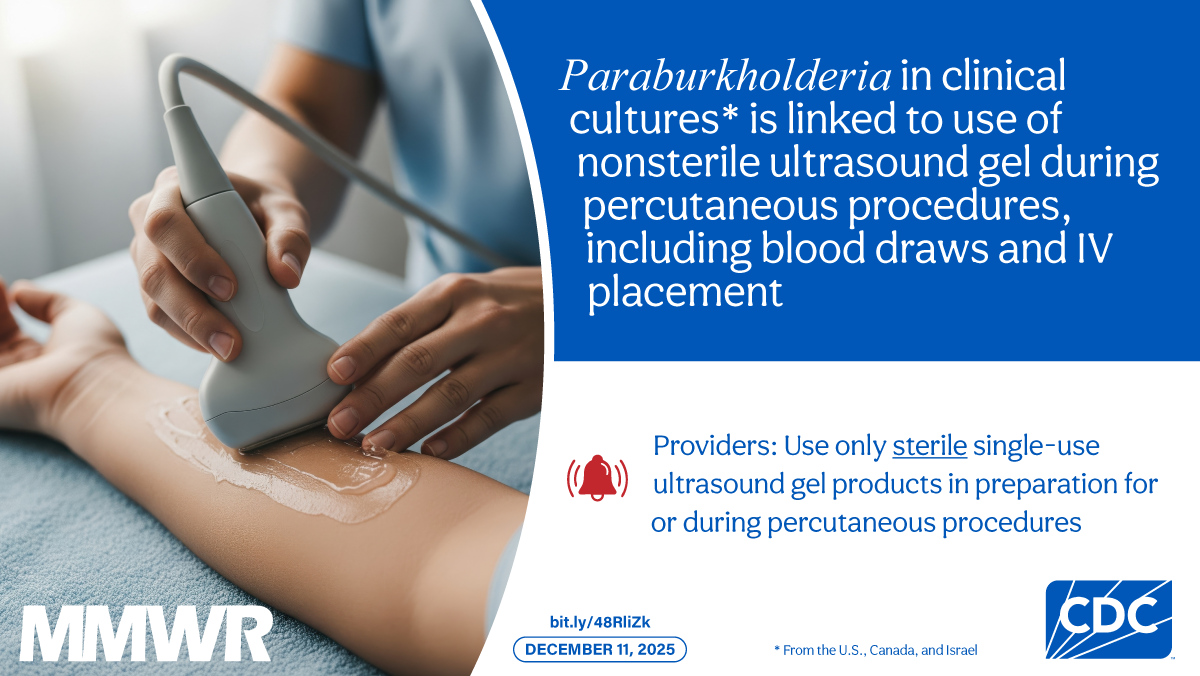
Whereas all positive cultures identified by MDH-PHL in the United States until October 1, 2024, involved the same blood culture system manufacturer, isolates from Israel involved a different blood culture system manufacturer, significantly decreasing the likelihood that intrinsic contamination of blood culture bottles with P. fungorum was the outbreak source. Investigation of cases in Israel with positive cultures from ascitic fluid obtained via paracentesis identified the use of nonsterile ultrasound gel (ClearImage brand) for point-of-care ultrasound (POCUS) for percutaneous procedures as a potential source of contamination. P. fungorum was subsequently cultured in Israel from six containers of the same ultrasound gel product, and WGS of these six isolates demonstrated genetic relatedness to clinical isolates from the United States, Canada, and Israel. Additional cultures from two different brands of nonsterile ultrasound gels in the United States (ClearImage and MediChoice) and Canada (ClearImage) both yielded genetically similar P. fungorum, including the same product that grew P. fungorum in Israel (ClearImage). In total, P. fungorum was isolated from six lots of nonsterile ultrasound gel from two different commercial brands (MediChoice and ClearImage) manufactured by a single company (NEXT Medical Products Company).
Whole Genome Sequencing
In total, WGS was performed on 43 clinical isolates from 42 patients,** nine ultrasound gel isolates (six from Israel, and one each from Canada, Minnesota, and North Carolina), and one historical clinical isolate from 2011.†† Sequence data were shared between Canada, Israel, and Minnesota, creating a joint genomic repository for real-time data analysis and cross-validation of results. WGS demonstrated that all clinical and gel isolates were closely related, exhibiting 0–10 single nucleotide polymorphism differences (Figure 2), confirming that all clinical and gel isolates belonged to a single clone of P. fungorum. This clone appeared to be very distant from the 2011 historical isolate, implicating contaminated nonsterile ultrasound gel as the source of P. fungorum. Further genome analysis demonstrated that the cluster was unrelated to publicly available genomes.
Characteristics of Patients with Isolates Linked by WGS
Medical records of patients in each jurisdiction were reviewed by members of the investigation team with clinical infectious disease expertise to obtain demographic and clinical characteristics. Where possible, health care providers who had performed an ultrasound-guided percutaneous procedure on the patient were interviewed on their use of ultrasound gel. Among 42 patients with positive cultures for P. fungorum genetically related by WGS in the United States, Canada, and Israel during May 2023–April 2025, 39 (93%) had positive blood culture results, the remaining three had positive cultures of ascitic fluid (Table). For one patient, three consecutive blood culture results were positive for P. fungorum over several days, and the patient received a diagnosis of a central-line–associated bloodstream infection (CLABSI)§§; no other patient had confirmed invasive P. fungorum infection based on the medical record review.¶¶ Among 37 patients with available clinical information, antibiotic therapy was initiated, modified, or extended for 28 (76%) in response to the positive culture result (e.g., to provide empiric coverage for gram-negative bacteremia or to provide specific coverage for Paraburkholderia bacteremia). According to medical record review, providers ultimately deemed Paraburkholderia to be a culture contaminant in 25 (68%) cases. In three patients with P. fungorum–positive ascitic fluid cultures, peritonitis was ruled out through clinical and laboratory findings. Sixteen (38%) of the 42 patients had a documented ultrasound-guided percutaneous procedure before or during specimen collection, most commonly peripheral intravenous catheter placement and blood collection in an emergency department.*** MediChoice or ClearImage nonsterile ultrasound gel use was confirmed in all facilities except one facility without information, with gel use confirmed for 15 (37%) patients, either through medical record documentation or health care provider interview.