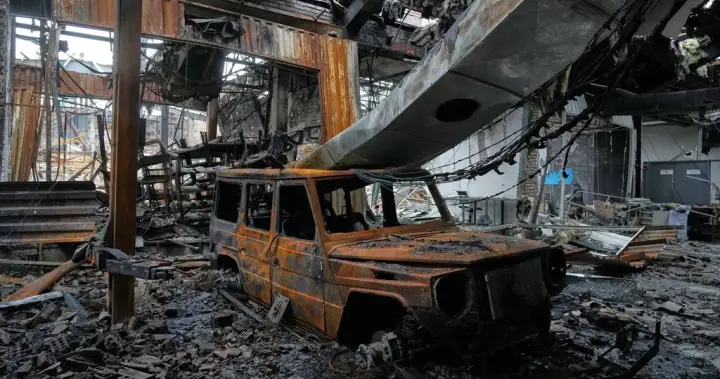
The widening Iran conflict has led to airstrikes on infrastructure across the Middle East and threats to target oil facilities, electricity production sites and desalination plants that supply civilians, which some experts say could amount to war crimes if carried out.

The 1949 Geneva Conventions on humanitarian conduct in war prohibit attacks on sites considered essential for civilians: “In no event shall actions against these objects be taken which may be expected to leave the civilian population with such inadequate food or water as to cause its starvation or force its movement.”
They explicitly prohibit attacks on “objects indispensable to the survival of the civilian population, such as foodstuffs, agricultural areas for the production of foodstuffs, crops, livestock, drinking water installations and supplies and irrigation works.”
The International Criminal Court cited attacks on critical infrastructure, such as electricity and fuel plants in Ukraine, in arrest warrants it issued for political and military leaders in Russia.
In July 2024, the ICC accused Sergei Shoigu, the former Russian defence minister, and leading Russian general Valery Gerasimov, of war crimes for targeting Ukraine’s power grid in the middle of winter.

Russia has denied allegations of war crimes and says it launched a special military operation in Ukraine in February 2022 in self defence.

Get breaking National news
Get breaking Canada news delivered to your inbox as it happens so you won’t miss a trending story.
In the ICC’s arrest warrant for Israeli Prime Minister Benjamin Netanyahu, judges “considered that there are reasonable grounds to believe that both individuals intentionally and knowingly deprived the civilian population in Gaza of objects indispensable to their survival, including food, water, and medicine and medical supplies, as well as fuel and electricity.”
The cutting off of electricity and reducing fuel supply “had a severe impact on the availability of water in Gaza and the ability of hospitals to provide medical care,” the judges found. The conditions “resulted in the death of civilians, including children, due to malnutrition and dehydration,” they said.
Israel also denies war crimes allegations and says it has targeted militants in Gaza and Lebanon in self defence against an existential threat.
Could these be ‘military targets’?
The Geneva Conventions and additional protocols say that parties involved in military conflict must distinguish between “civilian objects and military objectives,” and that attacks on civilian objects are forbidden.
This prohibition is also codified in the Rome Statute of the ICC, which is a court of last resort for 125 countries, but which does not include major powers such as Russia, the United States and China.

The Geneva Conventions say some infrastructure owned and used by civilians can count as a military objective, but only “objects which by their nature, location, purpose or use make an effective contribution to military action,” and whose destruction or capture “offers a definite military advantage.”
Where could violations be prosecuted?
A case on the current Middle East conflict is unlikely to end up in a war crimes court any time soon.
None of the Gulf states, Israel or Iran are members of the ICC.
That means there is no other institution with clear jurisdiction over alleged war crimes in the region.
Division within the U.N. Security Council, which can send cases to The Hague, means it is also unlikely that a case on the conflict is referred to the court.
National authorities could collect evidence of alleged war crimes and prosecute them under so-called universal jurisdiction laws, but there are currently no public cases.